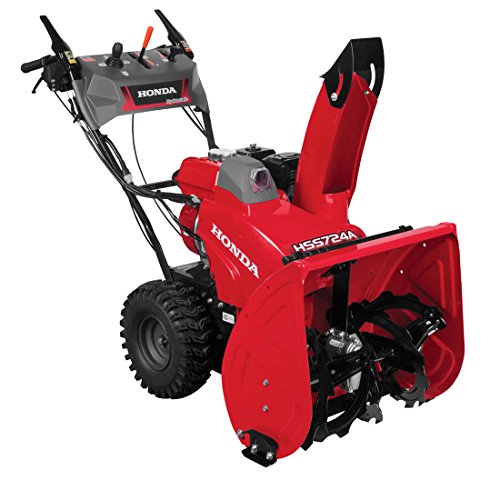
The Honda HSS724 is the middle child of Honda’s residential two-stage line: a 23.8-inch gas blower with the same electric joystick chute and hydrostatic drive as the larger HSS928, in a package that weighs less and costs less. We rank it third in our ranking of the best snow blowers of 2026, and it is the Honda we would suggest for most homeowners who want a gas two-stage machine without buying the biggest one.
The specifications here come from Honda’s product page for the HSS724AW and HSS724AWD. The page does not list drive speeds in miles per hour, so we leave those out. We do not test machines ourselves; the analysis below is based on the maker’s published specifications and general snow removal practice.
What Honda Says
According to Honda Power Equipment, the HSS724AWD offers:
- Engine: a Honda GX200 OHV engine, 196 cc, with a 0.82-gallon fuel tank.
- Clearing width: 23.8 inches, with a listed clearing height of 21.7 inches.
- Throwing distance: up to 49 feet.
- Capacity: up to 1,500 lb of snow per minute.
- Start: electric start with a recoil backup on the AWD; the AW version is recoil only.
- Drive: hydrostatic wheel drive, infinitely variable, with steering clutches and 14-inch pneumatic tires.
- Chute: a remote electric joystick, with a 198-degree range.
- Weight: a dry weight of 220 lb for the AWD and 209 lb for the AW. Dimensions are 58.5 x 26.4 x 43.5 inches.
- Features: an ice-breaking serrated auger, shear bolts, a 12V 6W LED work light, reversible skid shoes, a steel-reinforced housing and a chute clearing tool in the box.
- Warranty: three years residential and 12 months commercial, with optional extended coverage up to 36 months.
HSS724 vs. HSS928
The two machines share most of their feature list. What changes is scale. According to Honda, the HSS928 has a larger 270 cc engine, a 28.0-inch path, a 52-foot throw, a 1,900 lb per minute capacity and a 243 lb weight. The HSS724 gives up some of each: 196 cc, 23.8 inches, 49 feet, 1,500 lb per minute and 220 lb. See our profile of the Honda HSS928 for the bigger machine.
The practical difference is time and effort. A 28-inch path covers about 18 percent more ground per pass than a 23.8-inch path, so a wide, long driveway takes fewer passes with the bigger machine. For a typical two-car driveway, though, the difference in passes is likely to be modest. On the other side, a machine that is 23 lb lighter is easier to maneuver in a garage, onto a ramp or across uneven pavement.
How the Two-Stage Design Works
An auger pulls snow in and an impeller throws it. The serrated auger on this model is designed, according to Honda, to break up ice, and the shear-bolt protection is there so a hidden object breaks a bolt instead of a gearbox part. Honda’s 1,500 lb per minute capacity figure points to a machine built for deep, dense snow rather than thin slices. The hydrostatic drive is infinitely variable with one lever, so you set your pace to the snow instead of picking from a fixed set of gears.
For a driveway with a plow ridge at the road, the extra weight compared with a cordless or single-stage blower generally helps traction. Reversible skid shoes let you adjust the scraper height; on a gravel surface, keep the housing high enough that it does not scoop stones, and follow the owner’s manual for the adjustment.
Safety Notes for a Gas Machine
The U.S. Consumer Product Safety Commission says not to try to clear snow from the discharge chute with your hands, and notes that most snow blower injuries happen this way. Honda includes a chute clearing tool with the HSS724. Shut the machine down as the owner’s manual directs, wait for moving parts to stop, and use the tool. This applies to every snow blower.
Two more rules from the same CPSC page apply to a gas engine. Never leave a gas-powered snow blower running in an enclosed area such as a garage, because the exhaust contains poisonous carbon monoxide. And do not add gasoline to a running or hot engine; let it cool and refuel outdoors. These are basics, not a guarantee of safety, so read the whole manual.
Where It Works Best
- Typical to large suburban driveways. A 23.8-inch path and a 49-foot throw suit a standard two- or three-car drive.
- Deep and drifted snow. The two-stage design suits depths a single-stage cordless blower cannot handle.
- Owners with limited garage room. At 26.4 inches wide it is narrower than the HSS928, which is 30.5 inches wide.
- Anyone who wants electric start and a joystick chute without paying for the top machine.
Where It Falls Short
- Gas upkeep. It needs fuel, oil and an annual check, and you should not leave old gasoline in the tank over the summer. If you want to skip that, look at the EGO Power+ SNT2405, a cordless two-stage.
- Weight. At 220 lb it is not a machine you carry up steps.
- Narrower path. A very wide driveway means more passes.
Honda HSS724 vs. Husqvarna ST224
The Husqvarna ST224 is similar in size: a 24-inch two-stage gas blower, 23-inch intake, 206 lb. The Honda has the hydrostatic drive and the joystick chute, which are the features that matter during a long clearing session. The Husqvarna offers a friction-disc drive with six forward speeds and one reverse, a remote chute rotator, and a lower position in our ranking. The main difference in how they drive: Honda describes its single-lever drive as infinitely variable, while the Husqvarna steps through fixed speeds.
Who Should Buy It
The Honda HSS724 suits you if you have a mid-size to large driveway, get regular winter snowfall, are comfortable with a gas engine and want a machine that is easier to store and handle than the HSS928. It also makes sense if you value a long residential warranty: Honda lists three years.
Who Should Look Elsewhere
If you clear a very large property, the HSS928’s extra width and power save time. If you want no fuel or engine upkeep, a cordless two-stage is the closer match. If you only have a short drive and a walkway, a smaller machine will do.
Bottom Line
The HSS724 is a straightforward recommendation for a homeowner who wants Honda’s two-stage features in a more manageable size: GX200 engine, 23.8-inch path, 49-foot throw, electric start, hydrostatic drive and a three-year residential warranty. Its limits are the usual ones for a gas blower, plus a path that is narrower than the flagship. Use the button below to see the current listing on Amazon, and compare it with the other machines in our snow blower ranking.
See price on Amazon
Sources