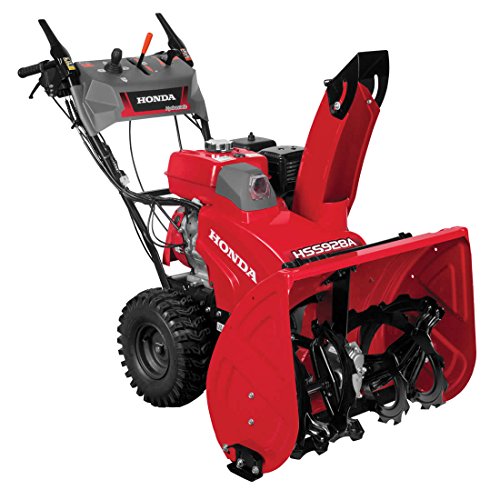
The Honda HSS928 sits at the top of Honda’s residential snow blower line. It is a 28-inch, two-stage gas machine with a Honda GX270 engine, hydrostatic wheel drive and an electric joystick for the chute. It is the machine we place first in our ranking of the best snow blowers of 2026, mostly because its specs describe a blower built for long, wide driveways and deep, heavy snow. This profile walks through what Honda says about the model, who it suits, and where it is overkill.
The numbers below come from Honda’s product page for the HSS928AW and HSS928AWD. The page does not list drive speeds in miles per hour, so we do not quote any. We do not test machines ourselves; the analysis here is based on the manufacturer’s specifications and on general snow removal practice.
What Honda Says
According to Honda Power Equipment, the HSS928AWD offers:
- Engine: a Honda GX270 OHV engine, 270 cc, with a 1.3-gallon fuel tank.
- Clearing width: 28.0 inches, with a listed clearing height of 21.7 inches.
- Throwing distance: up to 52 feet.
- Capacity: up to 1,900 lb of snow per minute.
- Start: electric (DC) start with a recoil backup. The AW version is recoil only.
- Drive: hydrostatic wheel drive, infinitely variable, controlled with a single lever, with steering clutches and 14-inch pneumatic Sure-Grip tires.
- Chute: a single articulated chute with a remote electric joystick, rotating 198 degrees.
- Weight: 243 lb for the AWD, 231 lb for the AW. Dimensions are 58.5 x 30.5 x 43.5 inches.
- Features: a serrated ice-breaking auger with shear-bolt protection, a 12V 6W LED work light, reversible skid shoes, a steel-reinforced auger housing, throttle control, an interlocking drive and auger control, and a chute clearing tool in the box.
- Warranty: three years residential, 12 months commercial, with optional extended coverage up to 36 months.
That is a long list of features for a residential machine, and it explains why this model is treated as a flagship rather than a starter.
Two-Stage Design and Why It Matters
A two-stage blower uses an auger to break up and gather snow, then a high-speed impeller to throw it out of the chute. The auger does the work of pulling snow in; the impeller decides how far it goes. Honda quotes 1,900 lb per minute for this model, which is the highest figure among the machines we cover. A higher capacity figure points to a machine built to keep moving through deep, dense snow rather than forcing small bites.
The serrated auger matters for packed or icy material, such as the ridge a plow leaves at the end of a driveway. Honda describes it as ice-breaking, and the shear-bolt protection is a common design feature: if the auger hits something solid, a bolt breaks instead of a gearbox part. Keep spare shear bolts on hand and read the manual for how and when to replace them.
Drive and Handling
Honda uses a hydrostatic drive that it describes as infinitely variable with a single lever. Compare that with friction-disc machines that offer a fixed number of speeds: with a hydrostatic system you can creep through a tight spot or move briskly along a long straightaway without shifting. Steering clutches let you disengage one wheel to pivot the machine, which helps at the end of a pass.
At 243 lb, the HSS928 is heavy. Extra weight generally helps traction, but it also means you will want a ramp or a flat, level path out of the garage. If your driveway is steep, the pneumatic Sure-Grip tires matter, but we cannot say how they perform on a given slope because Honda does not publish a grade rating on that page.
The Chute Controls
The remote electric joystick adjusts the chute direction from the operator position, with a 198-degree range, and Honda lists a single articulated chute. For a long driveway with a wind that changes direction, being able to redirect the stream without letting go of the handles is useful. The 12V LED work light helps with early-morning and evening passes.
Safety Notes for Any Gas Snow Blower
The U.S. Consumer Product Safety Commission, in its winter safety tips, says not to try to clear snow from the discharge chute of a snow blower with your hands, and notes that most snow blower injuries happen when people try to. Honda includes a chute clearing tool with this model. The owner’s manual describes how to shut the machine down and use that tool; read it before the first storm. This rule applies to every snow blower, gas or battery.
Because this is a gas engine, two more points from the same CPSC page apply. Never leave a gas-powered snow blower running in an enclosed area, such as a garage, because the exhaust contains poisonous carbon monoxide. And do not add gasoline to a running or hot engine. Let it cool and refuel outdoors. These are basic rules, not guarantees of safety, so read the manual for the full set of instructions.
Where It Works Best
- Long or wide driveways. The 28-inch path and 1,900 lb per minute capacity are suited to a large paved surface.
- Heavy, wet or drifted snow. The two-stage design with a serrated auger copes with density better than a single-stage cordless machine.
- Areas with plow ridges. The ice-breaking auger is built for the hard, packed pile at the end of a drive.
- Owners who want a joystick chute and electric start. Both are standard on the AWD.
Where It Falls Short
- Weight and size. At 243 lb and 30.5 inches wide, it needs real storage space.
- Maintenance. A gas engine needs fuel, oil and an annual service. If you do not want to deal with stale gasoline or a spring tune-up, a cordless two-stage like the EGO Power+ SNT2405 avoids that.
- Small driveways. If you only clear a short drive and a walkway, a machine this large is more than the job needs.
- Cost. It is a premium-tier model within our selection, and Honda’s own page lists it at a higher price point than the 24-inch HSS724. Use the Amazon button to check the current offer.
Honda HSS928 vs. HSS724
The smaller Honda HSS724 shares the same design language: electric start, hydrostatic drive, the joystick chute and a chute clearing tool. The main differences, according to Honda, are the engine (270 cc against 196 cc), the clearing width (28.0 against 23.8 inches), the throw (52 against 49 feet), the capacity (1,900 against 1,500 lb per minute) and the weight (243 against 220 lb). If your driveway is typical suburban size and you do not regularly face two-foot storms, the HSS724 is the more manageable choice. If you have a long drive, a lot of frontage, or regular heavy snowfall, the HSS928’s extra width and power is the point.
Who Should Buy It
The Honda HSS928 suits you if you have a large driveway, regularly deal with deep or heavy snow, are comfortable maintaining a gas engine, and have the storage space and strength to handle a 243 lb machine. It is also a good fit if you want to clear quickly rather than make many narrow passes.
Who Should Look Elsewhere
Look at a smaller model if your driveway is short, your storage is tight, or you would rather skip fuel and oil. The Husqvarna ST224 is a lighter gas two-stage at 206 lb with a 24-inch path, and the cordless EGO Power+ SNT2405 gives a two-stage path without an engine.
Bottom Line
On paper, the HSS928 is the most capable snow blower in our selection: the widest path, the highest capacity and the longest throw, from a maker with a three-year residential warranty. The tradeoffs are weight, upkeep and the usual rules for a gas engine. Use the button below to see the current listing on Amazon, and compare it with the rest of the field in our full snow blower ranking.
See price on Amazon
Sources