We earn a commission if you buy through our links, at no extra cost to you.
Best Snow Blower for Heavy, Wet and Deep Snow (2026)
Deep, heavy snow overwhelms small machines. How intake height, two-stage design and the chute rule shape the choice, plus four gas and cordless two-stage picks.
At a glance
For heavy, wet or deep snow, choose a two-stage machine. The Honda HSS928 has the widest path and a 52-foot throw, the cordless EGO SNT2405 avoids gas, the Honda HSS724 is a smaller gas option, and the Husqvarna ST224 adds a 23-inch intake at a lower price tier. Single-stage machines suit only light snow.
Light, fluffy snow is forgiving. Almost any snow blower will handle it. Heavy, wet snow is a different job. It packs into a dense layer, it sticks in the chute and it asks far more of the motor, the auger and your arms. Deep snow adds a second problem: a machine can only take as much snow in one pass as its intake is tall.
This guide explains what to look for in a machine for those conditions, and which models from our ranking of the best snow blowers of 2026 suit them. All specifications come from the makers’ own pages. We do not test machines ourselves, so we do not claim how any of them performs in a given storm. Where a maker leaves a figure out, we say so.
What Makes Heavy Snow Hard
Three things separate a tough storm from an easy one.
- Depth. The machine must fit the snow into its intake. Past that, it pushes snow instead of gathering it.
- Density. Wet snow weighs more per bucket and drags harder on the auger and the impeller. It is also stickier, so it clogs the chute more often.
- Surface. Heavy snow is often older, packed or icy. The ridge a plow leaves at the end of a driveway is a common example.
Those three explain the order of the checklist below.
What to Look For
Intake Height Against Snow Depth
The intake is the opening at the front of the bucket. Match it to the deepest snow you realistically see, not the average. The makers list these figures:
| Model | Type | Width | Intake / clearing height |
|---|---|---|---|
| Honda HSS928 | Gas, two-stage | 28 in | 21.7 in |
| EGO SNT2405 | Cordless, two-stage | 24 in | 20 in |
| Honda HSS724 | Gas, two-stage | 23.8 in | 21.7 in |
| Husqvarna ST224 | Gas, two-stage | 24 in | 23 in |
| Toro 60V Power Clear 21” | Cordless, single-stage | 21 in | 12.5 in |
Honda labels its figure “clearing height” rather than intake height, so the numbers may not be strictly comparable with EGO’s and Husqvarna’s. The point holds: the two-stage machines have an opening much taller than the single-stage model’s.
Two-Stage Design
A two-stage blower has an auger that breaks up and gathers snow and a separate impeller that throws it out of the chute. That split is what makes two-stage designs better suited to deep, dense snow. Single-stage machines throw the snow with the same auger that gathers it. They are lighter and handy for moderate snowfalls, but they reach their limit sooner. Toro lists an ideal depth of 9 inches for its 60V Power Clear, which is a useful reference. For snowfalls deeper than that, or for the heavy slush a plow leaves at the end of the drive, we recommend a two-stage machine.
Auger Design
Honda’s pages describe a serrated, ice-breaking auger with shear-bolt protection on both of its models, plus a steel-reinforced auger housing. The serrations help the auger bite into packed snow and ice, and shear bolts are designed to give way if the auger hits something hard. EGO lists a steel auger and a variable-speed auger on the SNT2405. Husqvarna lists a ribbon auger on the ST224, and a 10-year limited warranty on the cast-iron gearbox and impeller.
Throw Distance and Chute Control
Heavy snow is hard to throw, and a machine that can only move it a few feet leaves piles you have to deal with twice. According to the makers, the Honda HSS928 throws up to 52 feet, the EGO SNT2405 up to 50 feet and the Honda HSS724 up to 49 feet. Husqvarna does not state a throwing distance on its page, so we cannot give one. The single-stage machines in our ranking are listed at 20 to 42 feet.
Chute control matters in a storm because the wind changes. Honda lists a remote electric joystick that rotates the chute 198 degrees. EGO lists a 200-degree rear chute control with a rear deflector. Husqvarna lists a remote chute rotator and deflector.
Drive and Traction
Pushing a heavy machine into a wet drift is exhausting, and a drive system that keeps it moving matters. Honda lists hydrostatic wheel drive on both models with 14-inch pneumatic Sure-Grip tires. EGO lists variable-speed self-propel forward and reverse. Husqvarna lists a friction-disc drive with six forward speeds and one reverse, plus power steering and X-trac heavy-tread tires. None of the makers states a speed in miles per hour.
Four Machines for Heavy and Deep Snow
Honda HSS928: The Widest Path
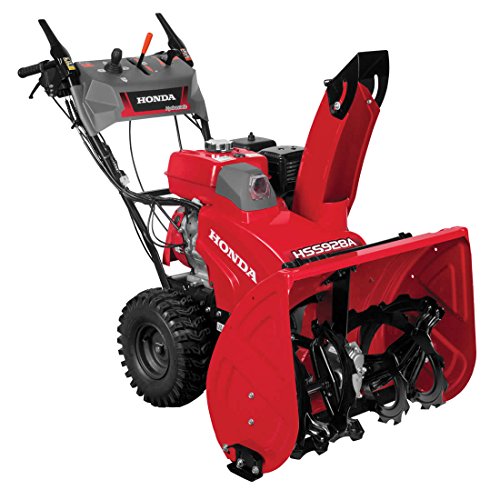
A 28-inch, 270 cc two-stage gas machine with a 52-foot throw and a joystick chute. Our first choice for long driveways and large storms.
According to Honda, the HSS928 has a 28-inch clearing width, a Honda GX270 engine, electric start with a recoil backup, a capacity of up to 1,900 pounds of snow per minute and a 52-foot throw. It weighs 243 lb. The serrated auger and the 198-degree joystick chute are the two features that help most when the snow is wet. It is the top pick in our ranking and also the most expensive. If your driveway is short, you are paying for capacity you will not use. The Honda HSS928 profile covers the details.
EGO Power+ SNT2405: Two-Stage Without Gas
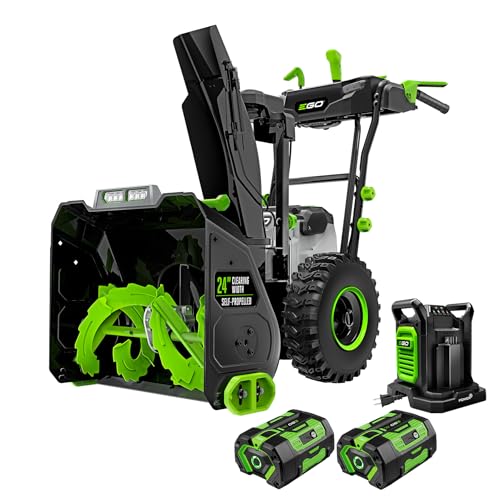
A 24-inch two-stage cordless blower with two 7.5Ah batteries, a steel auger and a 50-foot throw. For heavy snow without gas or a pull cord.
The SNT2405 is the only cordless two-stage machine in our ranking. According to EGO, it has a 24-inch width, a 20-inch intake, a throw of up to 50 feet, variable-speed self-propel forward and reverse, independent brushless motors for the auger and the drive, and four LED headlights. In its roundup, Bob Vila described it as built more like a traditional combustion blower and cited runtime of up to 135 minutes. That is a best-case figure. Wet, deep snow and high speeds shorten it, and Bob Vila notes the batteries take several hours to charge, so a very large storm may need a break. Read the EGO SNT2405 profile for more.
Honda HSS724: A Smaller Honda
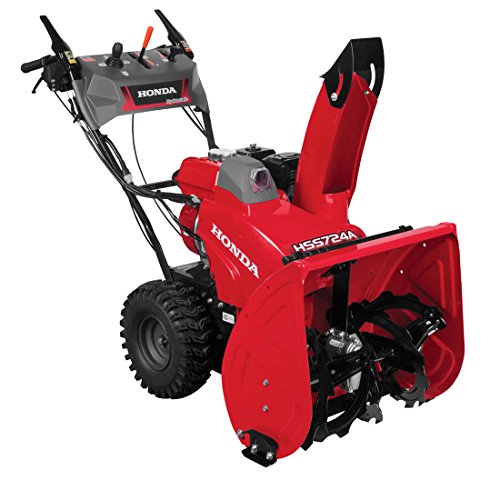
A 23.8-inch two-stage gas blower with the same serrated auger and joystick chute as the HSS928, in a lighter machine for mid-size drives.
According to Honda, the HSS724 has a 196 cc GX200 engine, a 23.8-inch width, a 49-foot throw and a capacity of up to 1,500 pounds per minute. It weighs 220 lb. It has the same serrated, ice-breaking auger and shear-bolt protection as the HSS928, so the main trade is width and throw. For a standard two-car driveway, it is the sensible choice among the Hondas. See the Honda HSS724 profile.
Husqvarna ST224: The Tallest Intake
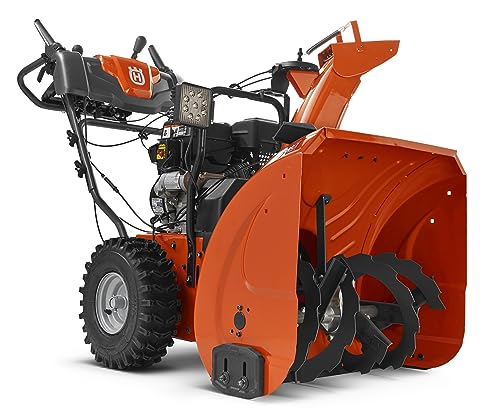
A 24-inch two-stage gas blower with a 23-inch intake, power steering and a 10-year limited warranty on the gearbox and impeller.
The Husqvarna has the tallest intake listed here at 23 inches, according to the maker. It lists a 5.9 hp (gross) engine, a ribbon auger, power steering and a weight of 206 lb. It has a plug-in electric start. Husqvarna does not state a throwing distance, which is the one question to weigh against the Hondas for heavy snow. It is the lower-priced gas model, and the Husqvarna ST224 profile has the full specification.
Where Single-Stage Machines Fall Short
The Toro 60V Power Clear 21”, the EGO SNT2122 and the Snow Joe cordless blowers appear in our ranking and suit light to moderate snow on pavement. In heavy, deep snow they run out of room: the Toro’s 12.5-inch intake and its 9-inch ideal depth, and the EGO SNT2122’s 13-inch intake, both sit well below the two-stage figures above. If you only get occasional light storms, they make sense. For a region with heavy lake-effect or nor’easter storms, we would not choose them as the main machine.
Technique for Heavy Snow
These are general practices, not maker instructions. Check your owner’s manual for limits.
- Take narrower passes. Overlapping by a few inches keeps the load on the machine lower than a full-width cut in deep snow.
- Slow the drive speed. The auger needs time to move what the intake gathers.
- Throw with the wind, not against it. A downwind chute keeps snow off you and off the cleared drive.
- Clear before it packs down. If snow is forecast to keep falling, a pass mid-storm is usually easier than one big job at the end.
Safety Notes
The rule that applies to every machine here, including cordless ones: never clear a clogged chute with your hands. The U.S. Consumer Product Safety Commission (CPSC) says not to try to clear snow from the discharge chute of a snow blower with your hands, and heavy, wet snow is exactly the kind that clogs it. Stop the machine as the owner’s manual directs, wait for moving parts to stop and use the clean-out tool or a stick. Honda supplies a chute clearing tool with both of its models.
For the gas models, the CPSC says never to leave a gas-powered snow blower running in an enclosed area such as a garage, because the exhaust contains poisonous carbon monoxide. It also says not to add gasoline to a running or hot engine. Move the machine outside before you start it.
How to Choose
- Long driveway, big storms: the Honda HSS928.
- Deep snow, no gas: the EGO SNT2405, and plan for the runtime.
- A normal two-car driveway: the Honda HSS724, or the Husqvarna ST224 if you prefer the tall intake and the lower-priced machine.
- Mostly light snow on pavement: a single-stage machine may be enough; see our guide to decks and sidewalks.
Sources
- Honda HSS928 official product page
- Honda HSS724 official product page
- EGO Power+ SNT2400 series official product page
- EGO Power+ SNT2124 21-inch official product page
- Husqvarna ST224 official product page
- Toro 60V Power Clear 21 in. official product page
- Bob Vila: best EGO snow blowers
- CPSC: Let it Snow and Play it Safe This Winter
Frequently asked questions
Why does wet snow clog a snow blower?
Wet snow is dense and sticky, so it packs in the chute and around the auger more readily than dry powder. A machine with a strong impeller, a wide enough chute and a way to clean it quickly copes better. Slowing down and taking narrower passes also helps.
How deep can a single-stage snow blower handle?
Toro lists an ideal depth of 9 inches for its 60V Power Clear 21-inch and a 12.5-inch intake height. That is the maker's guidance for a single-stage machine. For deeper or heavier snow, a two-stage model is the better fit.
What does intake height mean?
It is how tall the opening at the front of the machine is, so it limits how deep a single pass can be. According to the makers, the EGO SNT2405 has a 20-inch intake height and the Husqvarna ST224 has 23 inches. Honda's pages list a clearing height of 21.7 inches for both of its models.
Is a cordless blower strong enough for heavy snow?
The EGO SNT2405 is a two-stage cordless machine with two batteries working together in Peak Power mode. EGO says it can clear up to an 18-car driveway with 8 inches of snow on one charge. Heavy snow and high speeds shorten runtime, so treat that as a best case.
How should I clear a clogged chute?
Never with your hands. The CPSC says not to try to clear snow from the discharge chute of a snow blower with your hands. Stop the machine as the owner's manual directs, wait for moving parts to stop and use the clean-out tool. Honda supplies a chute clearing tool with both of its models.
Should I clear the snow all at once after a big storm?
For a very deep storm, it can help to clear in stages rather than in one pass, working from the top layer down. That is general practice rather than a maker instruction, so check what your owner's manual says about maximum depth and speed.